
Martingale vs Flat Collar: Which Does Your Dog Need?
July 25, 2026 · 8 min read
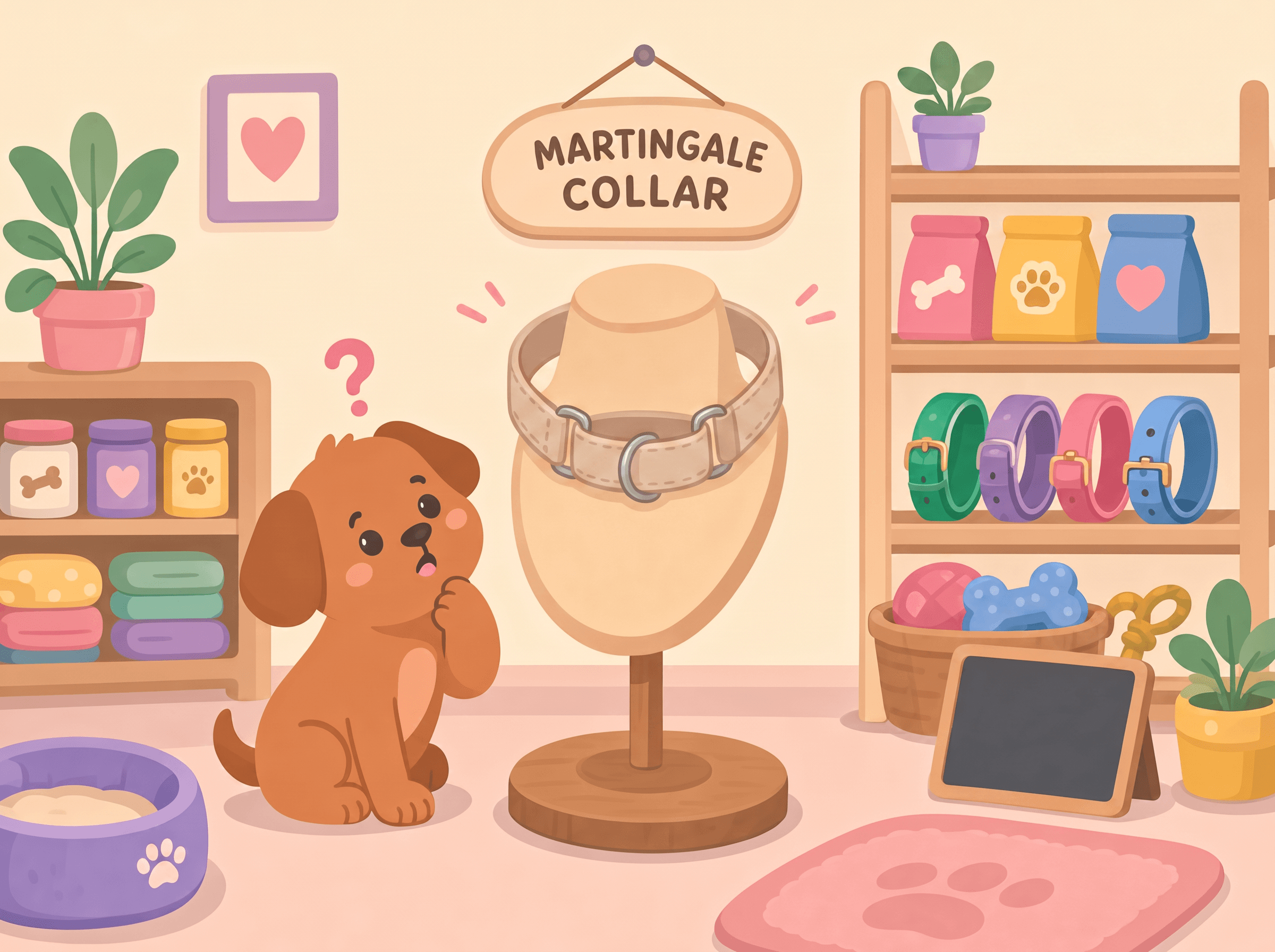
If you have ever watched a dog calmly back out of its collar and trot off, you already understand why this choice matters. Flat collars and martingale collars solve different problems, and the right pick depends on your dog's shape and habits more than anything else. Here is how each one works, a clear side-by-side, and a simple way to decide.
What is a martingale collar
A martingale is a limited-slip collar. It has a larger main loop that sits around the neck and a smaller control loop that the leash attaches to. When your dog pulls or tries to back out, the small loop draws the main loop closed, but only to a point: fitted correctly, it tightens just enough to stay on and then stops, so it never acts like a choke. It was designed for dogs whose heads are narrower than their necks, like Greyhounds and Whippets, that can slip straight out of a normal collar. The benefit is escape prevention with gentle, even pressure rather than a single point of force. The main caution is that a martingale should be supervised and never left on a dog alone or used as a tie-out, because the loop can snag.
What is a flat collar
A flat collar is the everyday standard: a single band with a buckle, usually a quick-release side-release buckle, and a D-ring for a leash and ID tags. It goes on and off easily, it is comfortable for all-day wear, and it is the right choice for the vast majority of dogs. Its one real limitation is that it cannot tighten, so a dog with a head narrower than its neck, or a determined backer-upper, can sometimes slip out of one if it is even slightly loose. For most dogs that is a non-issue as long as the collar is fitted to a proper two-finger fit. If a flat collar is the right tool for your dog, browse our collars for everyday options.
Side-by-side comparison
Here is how the two compare on the factors that matter most. Neither is better in the abstract; they are built for different dogs and different moments.
| Factor | Flat collar | Martingale collar |
|---|---|---|
| Control and safety | Great for everyday wear and ID; can be slipped if loose or the head is narrow. | Limited-slip design stops a dog backing out; gentle, even pressure when fitted right. |
| Comfort | Very comfortable for all-day wear; nothing tightens. | Comfortable when sized correctly; tightens slightly under tension, so supervise wear. |
| Training use | Fine for calm walkers and ID; pairs with a harness for pullers. | Useful for dogs that slip collars; offers gentle redirection without choking. |
| Breed suitability | Suits most breeds with a head wider than, or similar to, the neck. | Ideal for narrow-headed breeds such as Greyhounds, Whippets, and some Dachshunds. |
| Style and everyday wear | Huge range of patterns; easy on and off; best for tags and daily life. | More specialized; best reserved for walks rather than constant wear. |
Which one is right for your dog
The decision usually comes down to one question: can your dog slip a normal collar? If your dog has a typical head-to-neck shape and walks calmly, a well-fitted flat collar is all you need for everyday wear and ID. If your dog has a head narrower than its neck, or is a known escape artist that backs out of collars, a martingale for walks is the safer call. Narrow-headed breeds are the canonical case here, and a few of our breed guides flag the same slip risk, including Boston Terriers, Pugs, and especially the standard Dachshund, whose neck and head are close in width. For strong pullers of any shape, the best answer is often a harness for walks plus a flat collar for tags, which keeps pressure off the neck entirely.
Safety notes
Whichever you choose, fit is what keeps your dog safe. Use the two-finger rule: once buckled or adjusted, you should be able to slide two fingers between the collar and the neck. A martingale has one extra rule: when pulled fully closed, it should still be snug rather than tight, never closing far enough to choke, and it should be supervised and removed for unsupervised time and tie-outs because the loop can catch. For the full measuring walkthrough, see our dog collar size chart, or use the sizing calculator to get the number right.
The bottom line
For most dogs, a well-fitted flat collar is all you need for everyday wear, ID, and good looks. Choose a soft, durable, adjustable option, and use our sizing guide to dial in a safe two-finger fit. If your dog truly slips collars, pair a martingale for walks with a Dazey collar for tags.
Frequently asked questions
Is a martingale collar better than a flat collar?
Neither is better overall; they are built for different dogs. A flat collar is ideal for everyday wear and ID for most dogs, while a martingale is the safer choice for dogs that slip flat collars, especially narrow-headed breeds.
Are martingale collars safe?
Yes, when fitted correctly and supervised. A martingale should tighten only to a limited, snug point and never choke. It should not be left on an unsupervised dog or used as a tie-out, since the loop can snag.
Can a dog wear a martingale collar all day?
It is better reserved for walks. Because a martingale can tighten and the loop can catch on things, most experts recommend a flat collar for all-day wear and ID, and a martingale for supervised walks.
What dogs need a martingale collar?
Dogs with a head narrower than their neck, like Greyhounds and Whippets, and determined escape artists that back out of flat collars. Some Dachshunds, Pugs, and Boston Terriers also benefit because of their head and neck shape.
Does Dazey sell martingale collars?
Dazey makes soft, durable, adjustable flat collars, which are the right choice for most dogs. If your dog needs a martingale, choose a well-made one from a specialty maker, and use our sizing guidance to get the fit right.

Head of content
Siobhan leads content at Dazey, telling stories and writing guides for dogs and the people who love them.